People ask what there is to actually do on a quiet camping weekend, especially one without a big hike or a lake or any real agenda. The honest answer is: less than you’d think, and that’s the whole point. Here’s what one of those weekends actually looked like, hour by hour, start to finish.
Friday, 4:30pm: arrival
We pulled in with just enough daylight to set up without rushing. No itinerary beyond “get the tent up before it gets dark,” which took about forty minutes including a short break to figure out which stake went where. By the time the rainfly was secured, the golden hour light was already starting, and there was nothing left to do but sit down.
Friday, 6:00pm: dinner, slowly
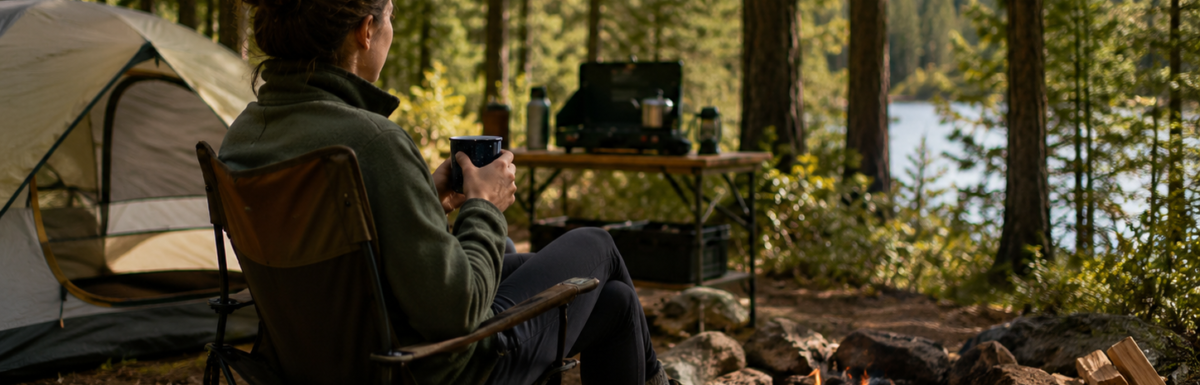
Dinner was intentionally simple: something we’d prepped at home, heated over a single burner while we sat nearby doing nothing in particular. This is the part that surprises people most when they hear about a slow weekend. There’s no elaborate camp cooking show happening. It’s closer to making a quiet dinner at home, except the kitchen is a folding table and the view keeps changing as the light drops.
Friday, 7:30pm: the fire, and not much talking
The fire went up small and stayed small on purpose. Conversation was slow and intermittent, the kind where nobody feels obligated to fill every silence. This stretch of the evening, roughly two hours with nothing scheduled, is usually the part people remember most fondly afterward, even though almost nothing happened in it. That’s not an accident. It’s the whole reason for the trip.
Friday, 9:30pm: into the tent
Lights out came early, earlier than any of us would go to bed at home, mostly because there was genuinely nothing left to do once the fire burned down. That’s another surprising thing about a slow weekend: your schedule shifts to match the actual daylight and darkness around you, without anyone deciding it should.
Saturday, 7:00am: coffee before anyone’s fully awake
Mornings at camp tend to start early too, usually with someone quietly making coffee while everyone else is still half-asleep in their bags. There’s a particular kind of quiet at a campsite in the early morning that doesn’t really exist anywhere else: no traffic, no phones buzzing, just birds and the occasional rustle from a neighbouring site.
Saturday, 9:00am: a short walk, not a hike
Rather than a big planned hike, the late morning was just a short walk down toward the water and back, maybe forty-five minutes total. It wasn’t about covering distance. It was about having a reason to move a little before the day settled into its slower rhythm again.
Saturday, 11:00am to 2:00pm: the long stretch of nothing
This is the part of the day that has no real name and no real plan. Cards got played. A book got read for twenty minutes before getting set down again. Someone napped in a camp chair in full sun for exactly as long as felt good and not a minute longer. If you tried to describe this stretch to someone used to a packed vacation itinerary, it would sound almost embarrassingly uneventful. It’s also the part of the whole weekend most worth protecting.
Saturday, 3:00pm: a slow lunch
Lunch happened whenever it happened, no fixed time, put together from whatever was easiest. This is one of the quiet luxuries of a trip with no schedule: meals stop being events you plan around and just become things that happen when everyone’s hungry.
Saturday, 6:00pm: dinner and the second fire
Saturday evening looked almost identical to Friday evening, which turned out to be exactly right. Repetition, on a trip like this, turns out to be part of what makes it restful rather than something that gets old. Nobody had to think hard about what came next because it was already familiar from the night before.
Sunday, 8:00am: the slow pack-up
Sunday morning had no rush to it either. Breakfast first, then a gradual, unhurried breakdown of the site, gear going back into the car in roughly the same order it came out. By late morning, the site looked exactly like it had when we arrived, and we were back on the road with nowhere in particular to be for the rest of the day.
What the weekend actually delivered
Nothing dramatic happened across those two and a half days. No big view, no notable hike, no story with a twist. What it delivered instead was something harder to put into words: a stretch of time where the pace of the day was set by daylight and hunger and tiredness instead of a schedule, a phone, or anyone else’s expectations.
Why the hour-by-hour version matters
Describing the weekend this way, hour by hour, is a little unusual for a camping post, but it’s the most honest way to answer the question of what there is to actually do. The answer, laid out plainly, is mostly nothing, on purpose, with just enough structure around meals and light to give the day a shape. If you’re used to vacations built around a full itinerary, this kind of weekend takes a little getting used to. Give it one full try before deciding it’s not for you. The appeal tends to reveal itself somewhere around Saturday afternoon, right in the middle of that long stretch of nothing.
What this weekend cost, in every sense
The site fee was modest, the food was simple and inexpensive, and the gear was nothing beyond the basics we already owned. What this weekend actually cost was closer to a night in than a night out: comparable to a modest dinner and a movie, but spread over two and a half days instead of a few hours. That math is easy to lose sight of when a slow weekend is unfairly compared to a much bigger and more expensive vacation.
That’s the real case for a slow weekend like this one. It won’t give you a dramatic story to tell. It will give you something quieter and, more often than not, something you actually needed more.